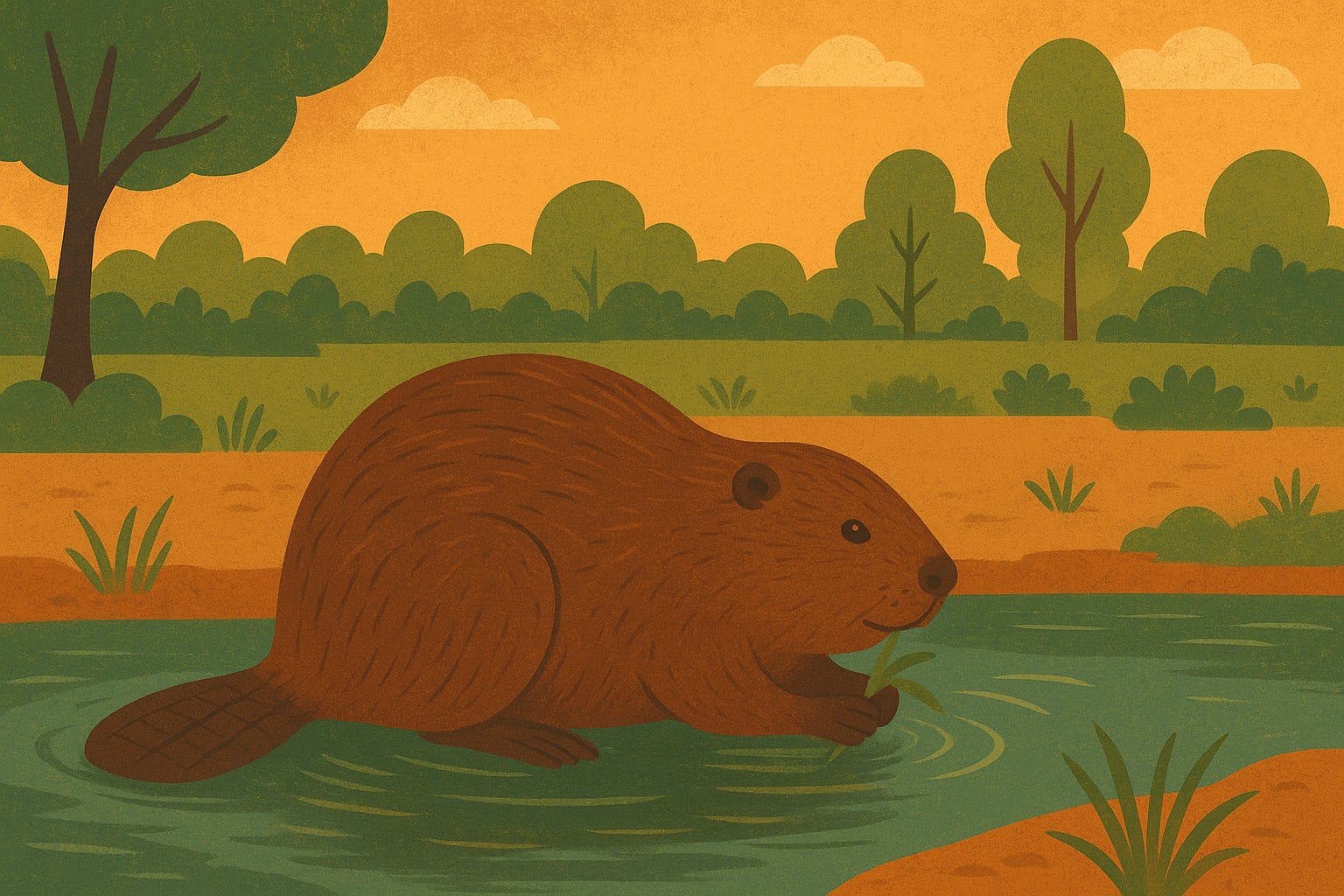

Rewilding – the process of reintroducing natural processes to landscapes – has fascinated me for years. In cities it’s far harder to do than in the countryside. So when I heard about a project in Ealing, West London, that has managed to reintroduce beavers into the UK’s capital, I was intrigued. My planned “beaver safari” with the project volunteers fell through because of a Tube strike, but the story didn’t. I’ll take you through my process of piecing it together today.
Step 1: Learning about the story
Once I had heard that beavers are back in London, I started to read more about them. Did you know that they were extinct in the UK for almost 400 years, even though they are a native species? This is mostly due to their valuable fur and castor oil, but they also got hunted by farmers who were not amused by having their land turned into wetland corridors.
However, nowadays we can really use the effect that beavers have on land: They flood it in a controlled way. Urban areas face both droughts and flash floods – exactly the conditions that beavers mitigate. The wetlands they create are important ecosystems that store water, while also being able to take on a lot of excess water and slowly release it into the ground.
Step 2: Pitching the story
There were already a few articles about beavers out there, for example on Reasons to be Cheerful – one of my favourite solutions journalism outlets! I sent several pitches out to nature-focused magazines and the one for Bluedot Magazine, an environmental outlet from the U.S., commissioned me for a short story.
Step 3: Visiting the site
Whenever I write about an urban innovation, I try to make sure I can see it in person. That’s not always possible, but of course, in this case it was relatively easy. Even though I missed the late-summer beaver safari – one of the last ones, since beavers are easiest to observe on a summer night -, the team at Ealing Wildlife Project and Citizen Zoo graciously suggested a private walk-around of about half an hour after one of their meetings.
When I got to Ealing, a volunteer-led walk around the beaver site was about to start as well. I got to share some of the excitement of the local families and the official Urban Beaver Officer, Şeniz Mustafa, who took them on a walk. Pia Trevelyan-Ashby, urban rewilding officer at Citizen Zoo, arrived briefly afterwards to show me around the beaver’s habitat. It’s a publicly accessible space that used to be the site of anti-social behaviour such as littering and drinking in public. Now, it’s a proper park that is clean and respected in the community.
Unfortunately, we didn’t get to see any beavers, which I had been warned about. But we saw lots of their traces, including on trees, and their “workshop area” where they gnaw on wood and collect the best branches to build dams. It was also really interesting to get an impression of how much wetland they had created.

Step 4: Conducting the interview
While we walked, I did my best to interview Pia in a semi-structured way. I often do interviews on Zoom, where I typically record and then transcribe the audio file. In this case, I had some questions prepared in my notebook, aligned with the four pillars of solutions journalism – what’s being tried, what evidence exists, what the limitations are, and how the community is involved.
I write about two questions on a page with lots of space in between. Often, conversations don’t go linear, or the interviewee will answer several questions at once, so there’s a lot of scribbling involved! I make sure to do a literal transcription of particularly good quotes. I also typically offer the chance to approve the quotes before the article goes live, as that’s what I would want myself as an interviewee.
For the last question, which I asked just as we were nearing the end of the tour, Pia referred me to her colleague Elliot, who was just around the corner. I gave him the quick elevator pitch of who I am and what I’m writing about before briefly getting his very helpful input as well.
Step 5: Writing up the story
For this story, I knew that I only had around 450 words. I first wrote down all my handwritten notes into a Word document. I did this as soon as I came home to make sure that I remembered as much as possible. I then added some personal impressions and more research on beavers and on the project. In a next step, I highlight the best quotes and organise them, together with key information, into response – evidence – limitations – impact, which helps a lot with the logical flow of the article. The hardest part was choosing what to leave out, especially around the ecological background of rewilding. Focusing on the four pillars of solutions journalism helps to stay disciplined. Next, I used AI to check flow and clarity as well as any spelling mistakes.
The magazine had also asked for some pictures, so I offered one of my own from the site visit, as well as one from Citizen Zoo – of course after making sure that I could use their picture and which copyright I should put. For this kind of article, pictures are particularly important, I think – they show habitat changes as well as community involvement and the story’s protagonists, the beavers. To make the editors’ work easier, I copied everything into a Google Doc so that we could work on it together.
After some edits, I had a final version that my two interviewees approved as well. A day later, the piece went online! You can see it here:
https://bluedotliving.com/beavers-are-back-in-london/
I hope this was helpful! Would you like more behind-the-scenes posts – maybe on pitching to editors, interviewing, or structuring a solutions story? Leave a comment below!