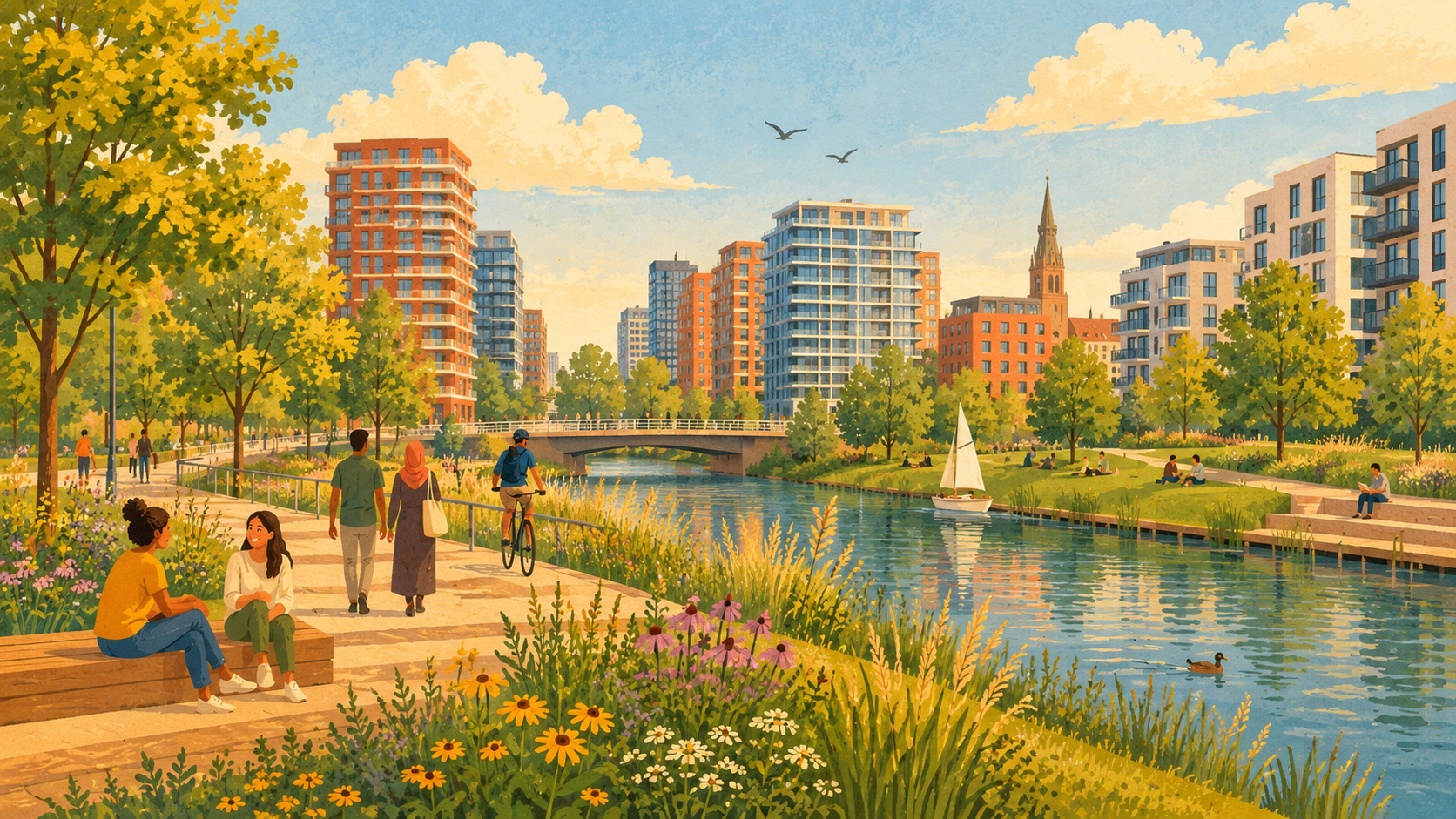
Water shapes our landscapes and our cities. It offers great potential for trade and commerce, for public spaces and leisure, for cooling the city, and for transportation – but it also often threatens cities with floods.
Earlier this month, I attended the conference “WATER CITY_WHERE NEXT?” in my hometown Hamburg. Like many cities, Hamburg’s port had to adapt drastically when container shipping became the new norm in the 1960s and 1970s. Today, the parts of the port that are too small for large-scale industrial freight are turning into parks, new residential and office areas, and new public spaces. “The park is already there”, Prof. Vogt from Zurich’s ETH said in his keynote address. “We have to understand the basics of water as public space first: how to make it accessible, where are the lines of sight, what is the choreography?”
Many cities presented their answers to “liquid public space” during this conference. Here are some of my favourites:
A new neighbourhood: The Grasbrook development in Hamburg
Since the year 2000, Hamburg has been actively changing formerly neglected part of its old port into the “HafenCity” – a vibrant new quarter with a university, new parks, residential buildings, schools, ferries and new bridges. Over 10 km of promenades have been created alongside the water to make it accessible. The amphitheatre-like staircase opening to the water, a staple of waterfront landscape architecture, appears throughout.”. Overall, HafenCity has expanded Hamburg’s inner city area by around 40%, according to urban planner Andreas Schneider from the HafenCity project.
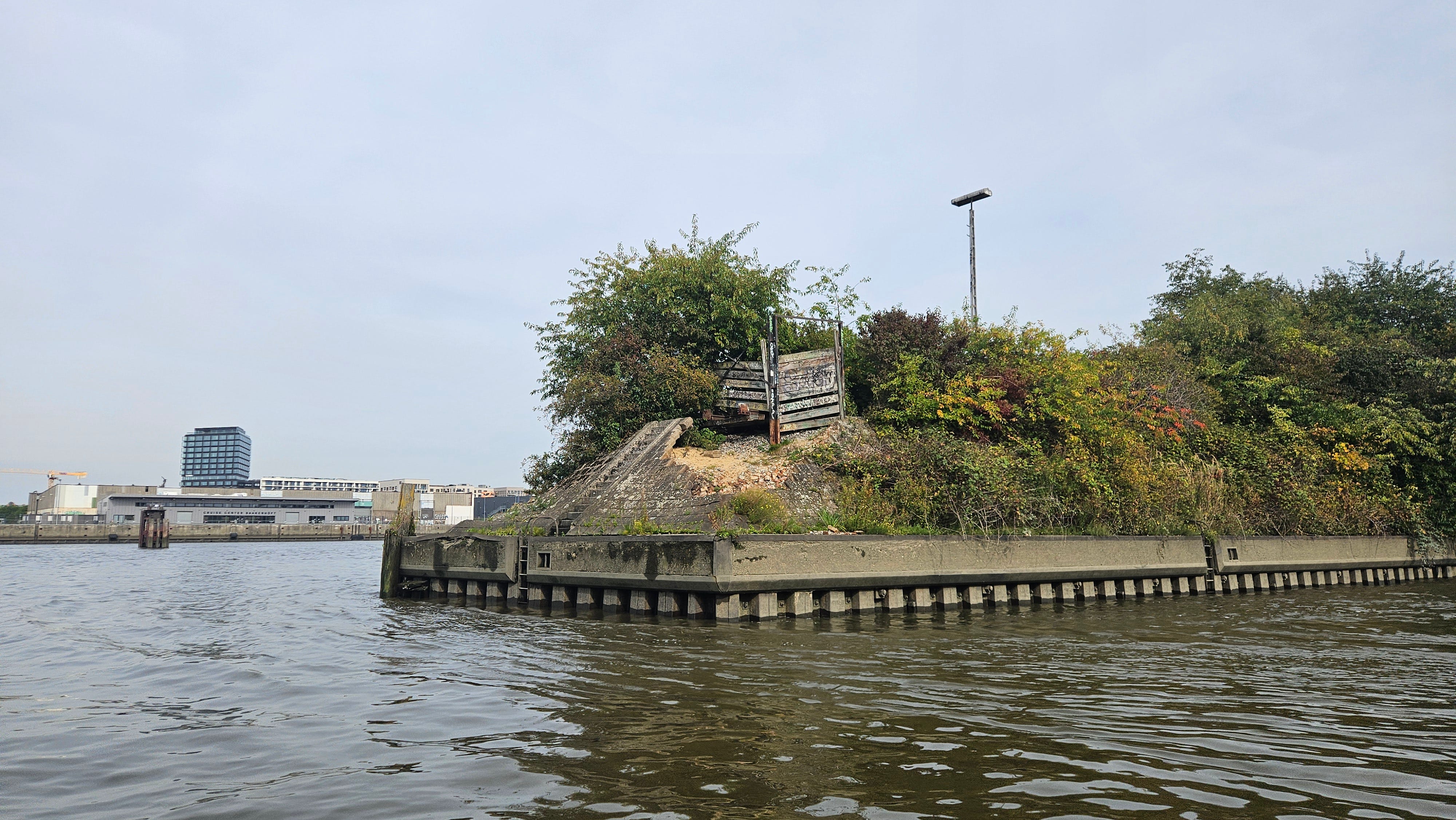
Another big project is the development of the Grasbrook island. Like all of Hamburg, it needs to be flood-proofed before construction for human habitation can begin. The river Elbe is tidal and regularly has a difference in tidal range of up to 3.8 metres. Aprt from floods and rising tidal levels, storm surges are a worry: The worst onesin 1962 and 1976 reached up to 6.45 metres. New developments now plan for a protection of 8-10 metres. Public space can sit on top of this: For example, Zaha Hadid Architects have designed the beautiful, floodable promenade Niederhafen on top of the flood protection barrier.
Grasbrook will provide for up to 9.7 metres flood level. It will have a ferry port and offer docking space for ships that cannot pass the nearby bridges “Elbbrücken” when the water is too high. It is planned as a pedestrian-first development with underground parking. As a very green neighbourhood, roofs and facades will be greened. Of course, it is also a sponge city. Construction will start in late 2028 and completion is planned for the mid 2040s. Around 6,000 people will live here and 14,000 work spaces will be created – as well as schools, doctors’ offices, a museum, and a nearby metro station.
Creating new habits: vertical wetlands
Hamburg’s river Elbe and all its tributaries offer a very particular water habitat: Fresh water with large tidal differences. The “Stiftung Lebensraum Elbe” works on creating a blue-green band of biotopes across the river Elbe that will be a critical infrastructure, allowing all organisms in the area to move between bodies of water – including humans. For this, we need better water-land-connections along the riverbanks. Outside of Hamburg, this looks like rewilding the river Luhe in Lower Saxony’s town Winsen, focusing on providing tidal habitats for small creatures; creating new tidal creeks in Schleswig-Holstein; and turning steep shores into gentle slopes.
The project “Hamburg, deine Flussnatur” focuses on 380 km of riverbanks in the city and their surroundings with several hundred interventions – informed by a participatory process that took place from 2022 to 2024. “These will be the new favourite spaces of everyone in Hamburg”, Dr. Elisabeth Klocke promises.
Interventions will include vertical wetlands in the Südkanal: plantable baskets attached to canal walls that have roots hanging in the water. In Berlin, in 2023, Spandauer Schifffahrtskanal did the same. Today, the reeds of the pilot wetlands are 3.5 metres tall. “Fish came to hide in and feed off the roots, once the reeds were grown, and today it is around 10°C colder than in the surroundings – from heat islands to cool islands,” Dr Klocke says.
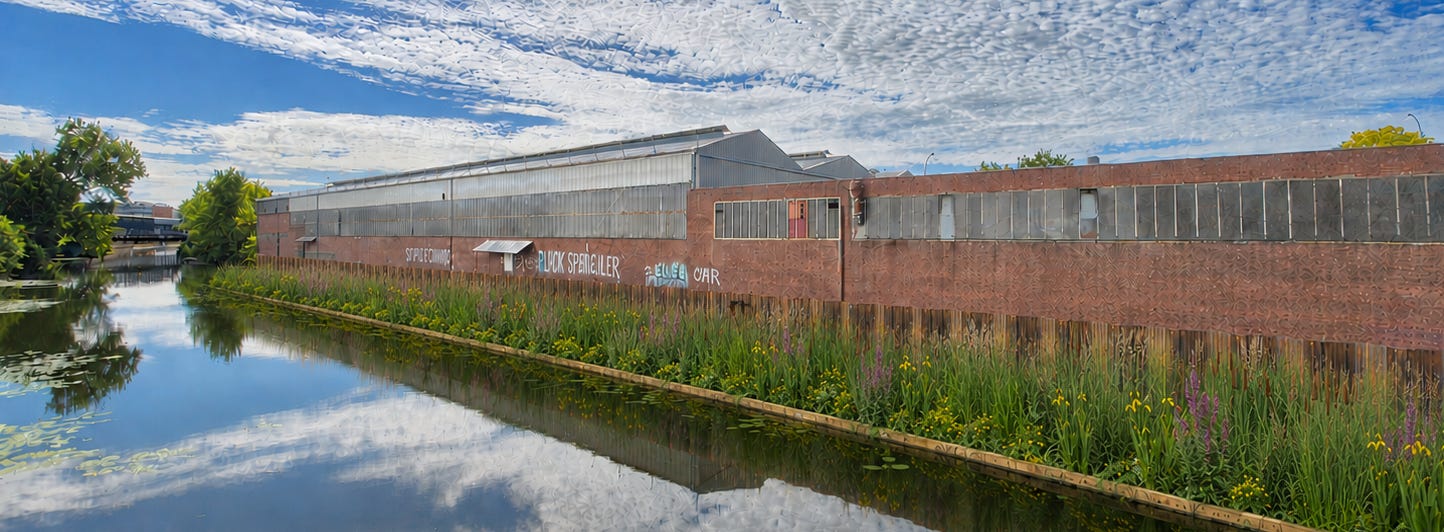
The foundation aims to rewild not just the canals but also the existing brooks in Hamburg. In Hamburg, as in most cities, canals were designed to move water out as quickly as possible; now the new goal is rewilding. This has to be supported by the citizens, which is why the foundation invests in activities like joint clean-ups, education around the environment, and neighbourhood engagement.
A holiday by the water for everyone: Pier 22 in Vienna
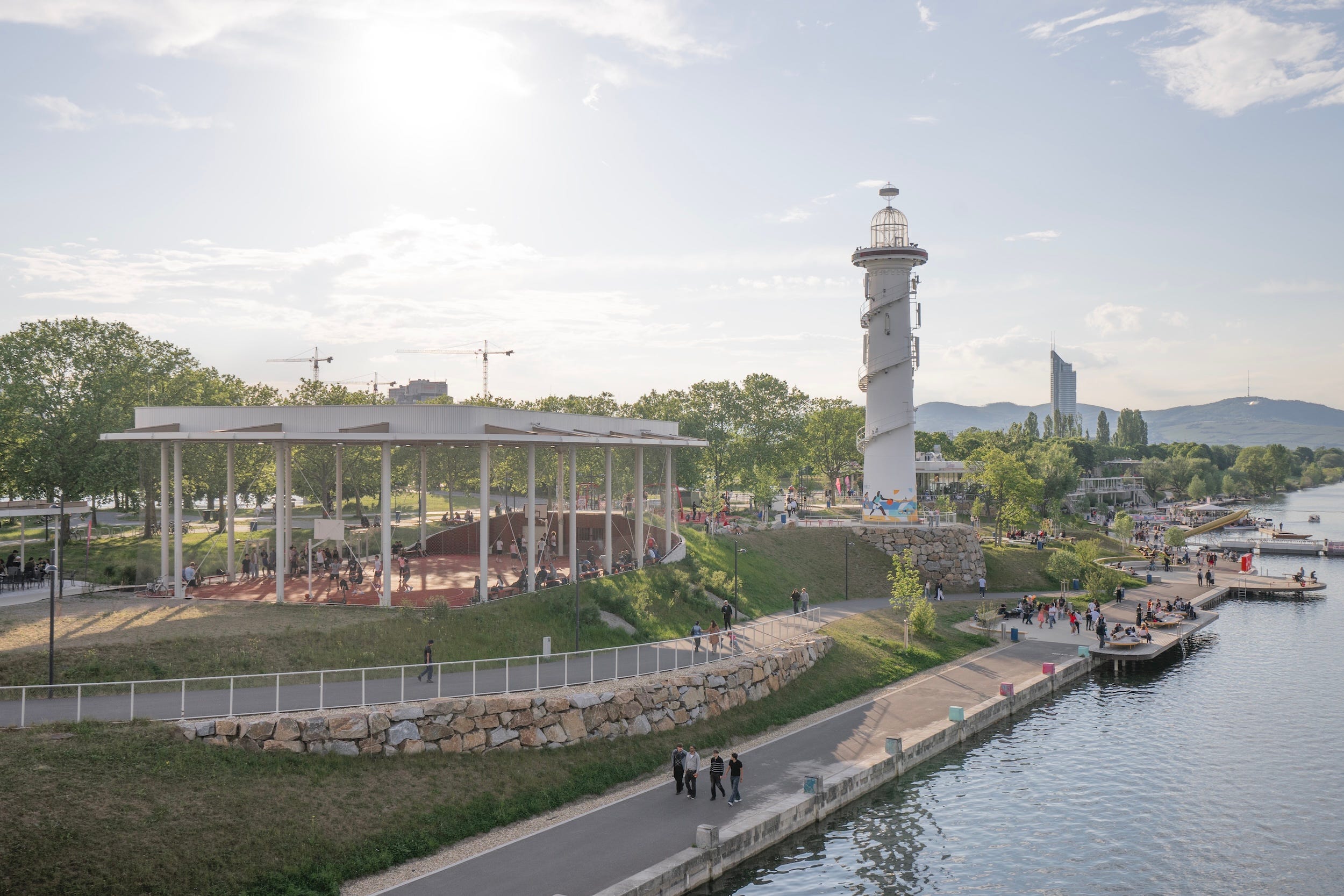
Vienna’s Danube Island has a different answer to the question of who water is for. Stretching over 21 km², this green peninsula sits just ten minutes from the city centre. The design brief for its new Common Space Pier 22 was deliberately ambitious: a third space where consumption is not necessary or encouraged.
The result by Austrian architecture office Most Likely combines a swimming pier, sports facilities, co-working space, and cultural programming alongside renaturation and flood protection elements. The governing idea, as the project team put it, is “holiday for everyone”: leisure as a public right rather than a commercial offer. In a city known for its commitment to public infrastructure, Pier 22 extends that logic to the waterfront.
So, water cities were created with a commercial purpose but are increasingly framed as a public good. Who does the water belong to? How do we create waterscapes that are enjoyable for everyone and mitigate against climate change at the same time? These are the questions the conference left me with.
What do you think of a new culture of planning and building with the water, not by the water?