By Hirwa Hans Harelimana
In places like Jacobabad, Pakistan, summer temperatures can reach 50°C (122°F). With little to no access to water and unaffordable electricity to run air conditioners, residents resort to wrapping wet cloth around their heads and necks to cool down. This level of extreme heat disrupts sleep, caregiving, and daily routine. Home-based workers, predominantly women working as cooks or maids, lose vital income when indoor temperatures become intolerable. As temperatures rise, so do the number of people living in conditions in which they are less protected from the heat. For the urban poor, the ability to adapt and build heat resilience is no longer a future projection but a reality challenging livelihoods on a daily basis.
Despite these well known health risks, extreme heat rarely attracts public attention. When it does, it’s usually in a seasonal pattern like now as European cities debate air conditioning during a summer heatwave. But extreme heat is no longer seasonal. In fact, it’s become a constant threat and the risks fall the heaviest on the urban poor. From collecting more accurate data on heat to investing in incremental housing upgrades, cities across the Global South are deploying solutions grounded in protecting those facing the highest risks from heat stress.
Cooling homes first
On a blistering summer day, most of us can simply stand under a tree or step into an air-conditioned room. But for someone living in a neighbourhood of tightly-packed houses with metal roofs, these options are luxuries. In many cases, slum dwellers are even more vulnerable to heat stress inside their own homes. A recent study across Kenya, Tanzania, and Zimbabwe revealed that temperatures inside informal dwellings can be up to 9°C higher than outdoor temperatures. In some of the neighbourhoods, indoor temperatures can go as high as 45°C (113°F) during a relatively cool season.
However, cooling homes is not simply distributing and installing new appliances. It requires careful planning responding to the needs of residents most exposed to heat, whether it is due to the physical structures of their homes, their neighbourhoods or social economic status. There is now a general consensus among urban practitioners and researchers that interventions are best delivered when local communities actively participate in assessing what should be implemented to their benefit. A global campaign called Roof Over Our Heads (ROOH) exemplifies this community-first approach. The project kicked off in 2022 to tackle the housing crisis that vulnerable communities in informal settlements face. In India, ROOH researchers gathered local affiliates and women in saving groups to discuss what they needed and the challenges they faced to get it. Housing emerged as a top priority. Most of the residents were wage laborers, self-building and self-financing their homes, often with second-hand material vulnerable to extreme heat and heavy rainfall. To improve housing conditions, ROOH set up learning labs in informal settlements of 9 cities. Residents used these spaces with technical experts to test adaptation materials, co-design upgrades, repair, retrofit, and rebuild houses.
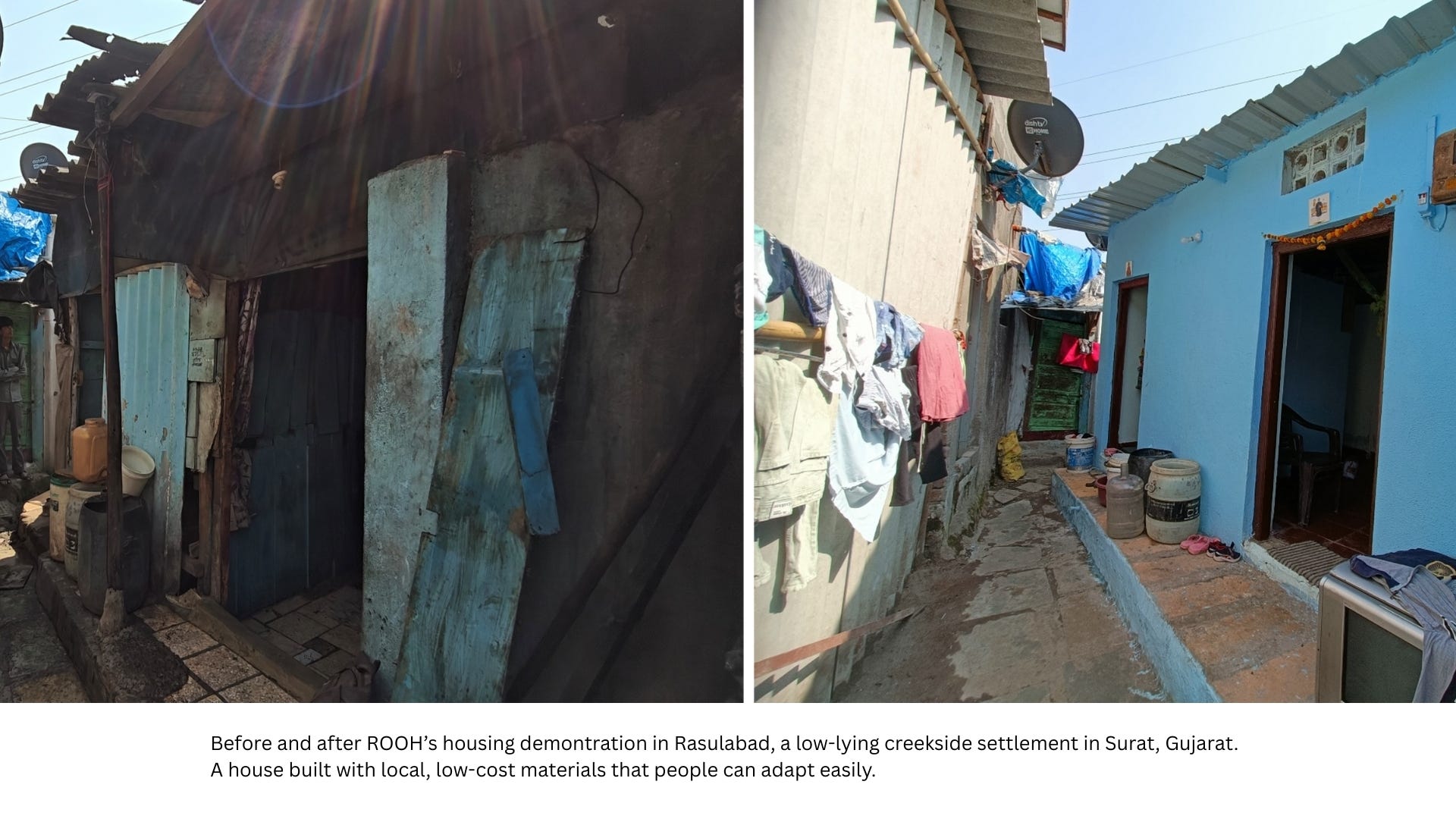
Source: Global Center on Adaptation.
The aim of ROOH was to make housing safer, more comfortable and better prepared for heat and flooding. In the city of Surat, located in the west Indian state of Gujarat, ROOH noted that homes built with metal roofs and poor ventilation intensified heat. Instead of rebuilding the houses entirely, efforts in the Rasulabad settlement went toward low-cost incremental upgrades. Local masons, women, and residents gathered in workshops, testing different materials like egg trays as an insulating layer to reduce heat indoors. One of the houses served as a demonstration, using pre-painted galvanised iron sheets, insulation, vedic plaster and terracotta floors. These changes lowered indoor temperatures by 5-7°C (41°F – 44°F). In the photos above, an ROOH participant expressed feeling cooler inside their home thanks to new solar-reflective coatings. Each one of these outcomes was a result of peer-to-peer knowledge sharing, as solutions were tested, refined and deployed.
Building localised heat data
Cooling individual homes is only half the battle; entire neighbourhoods need to adapt equally. To mobilise municipal action, communities are building their own data on heat. Most public weather data relies on satellite imagery. However, satellites measure surface brightness and then scientists use computer models to estimate temperature, often missing the actual air temperature and humidity we feel on the ground. This data blind spot leaves informal settlements at risk and excluded from climate adaptation planning.
In 2023, the Onekana initiative set out to fix this. A collaboration between the grassroots organisation Community Mappers, the University of Twente, and UN-Habitat, the initiative co-designed workshops with community leaders to identify key spaces most affected by heat in Nairobi’s Korogocho and Kibera urban settlements. Local residents trained to use low-cost sensors, walking through markets, clinics, and schools to capture real air temperatures. They paired this data with micro-surveys detailing housing materials, ventilation, overcrowding, and access to services. Like the ROOH project, the findings from this initiative directly informed low-cost housing and public space interventions like roof insulation and public shading.
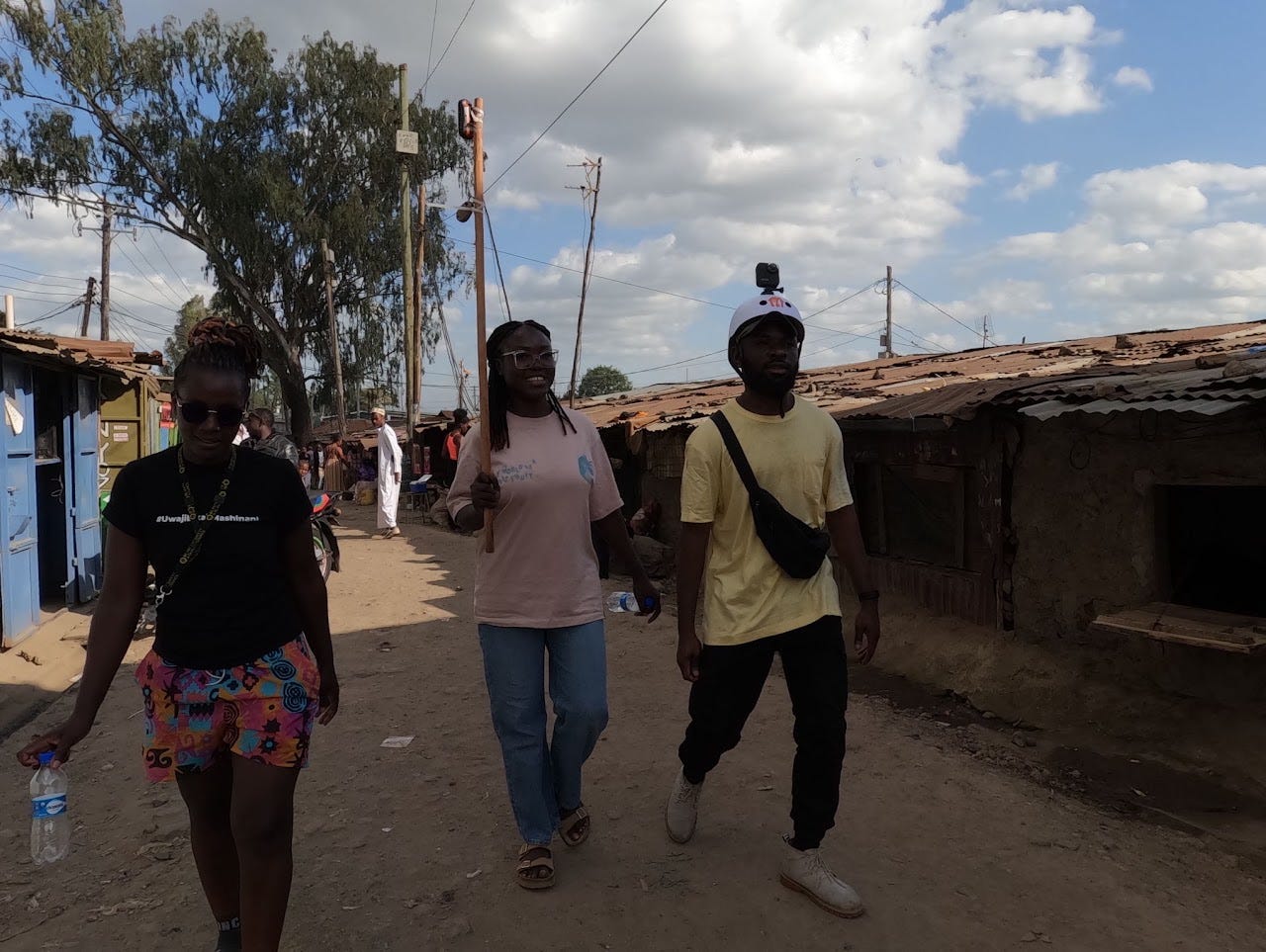
Youth from Korogocho and Kibera settlements during fieldwork. Source: Onekaka Project
Findings from this initiative show that genuine collaboration between technical experts and community members is key in an urban intervention. For an urban planner, it is not only enough to know the number of settlements that need upgrades. Engaging residents in conversations will enhance the planner’s role, feeding them key information on adapting interventions based on the specific needs and socio-economic conditions of various households. This is the type of inside knowledge that a planner may not find on a map and yet a lived reality that affects any outcome.
Changing mindsets towards slums and their residents
The main takeaway from ROOH and Onekana is that valuing context guides success. Matching technical know-how with local, lived experience and knowledge allows global climate agendas to translate into actual solutions on the ground.
Despite ample local knowledge, slums remain invisible to policy. For example, without formal land tenure, these low-cost retrofits cannot be easily scaled to protect the hundreds of millions in climate-threatened cities. Historically, housing policy toward informal settlements has mostly led with one approach; “slum clearance” in many cases destroying homes, communities, and livelihoods for new high-rise buildings and short-term profitability. But discussions at the 13th session of the World Urban Forum (WUF 13) in Baku, Azerbaijan, suggested a shifting tide. Urban practitioners, governments, and international organisations are increasingly calling to move away from a previously destructive approach.
With active community participation and collaboration with experts, the ROOH and Onekana projects highlight a more constructive approach to urban interventions. As cities grapple with overlapping challenges and priorities, incremental but localised solutions down to the neighbourhood level become even more vital to achieve tangible results.
This article was written by Hirwa Hans, an urban economist and an alumnus of the Urban Solutions Journalism Academy run by Laura Puttkamer, who also edited this article. The next Academy will take place on September 24, 2026 – stay tuned for more details!